Quick update! Blue Pentel Leads! In .09, .07, & .05 at the Pentel website. Poked around a bit looking for the brush pens too, but didn't see them, but I won't pretend to have done a thorough look there. Anyhow, now y'all know where to look when you can't find them in art stores. Happy Saturday!
-MK

March 10, 2007

February 28, 2007
MK Reed
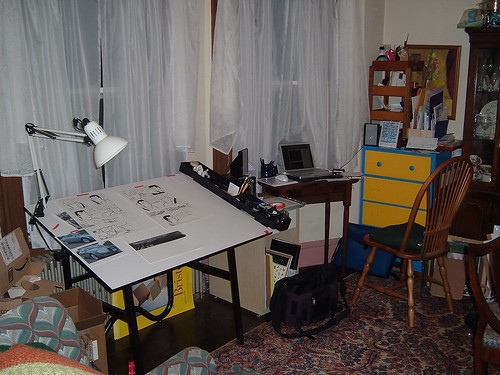
My studio, wedged between the china cabinet & a recliner.
Comics: Catfight, Pale Fire, Cross Country
Website: mkreed.com
Making comics since year of:stories since roughly 2000, little stuff since I was a kid
Art education/schools attended: attended Syracuse University, but for English, not art, just snuck art classes in where I could
Tools
Pencils: I use mechanical pencils, usually .07 lead of various brands & types, or 2.0 Steadler HB, and I pretty much always sketch with blue lead. I have a stash.
Inks: P.H. Martin's Black Star Matte. Some P.H. Martin's transparent watercolors for greys, and recently I've been trying tubes of Windsor Newton watercolors for grey tones as well.
Brushes: Raphael 8404, usually #0, for lines. Crappy synthetic nylons for watercolors. (for now, I'm still experimentig, but I don't want to ruin brushes that cost $10+ when I don't know what the difference is. Once I get used to painting with watercolors, I'll upgrade.
Pens: Faber Castell Pitt pens, for lettering, and sometimes in lieu of brushes. I have a Pentel Japanese brush pen that puts down very lovely lines, but I have yet to use it for anything beyond sketching. I've also tried the G nibs & have been considering makeing more regular use of them.
Paper: Strathmore 300 plate, and my usual pages are on 11x 17. For special occasions, I'll upgrade, and go for 400 or 500. (I made this as a wedding present and I think it was on 500 2 ply.)
Lettering: Faber Castell Pitt Medium/Fine pen. Usually without a guide.
Color: I don't often use color. It's nerve wracking when I do. I've used Photoshop, and I've used Gouache. I prefer doing it by hand where I can.
Layout/ Composition: I write everything in my sketchbook & do the layout as I write. Usually by the time I've writen something down, I've thought about it for so long that I don't do many revisions.
Convention Sketches (when different from illustrations done in the studio): Depends on what I have in the lunchbox. My favorite writing pen is the super thin Uniball Vision Elite with Blue/Black ink. (That's not Blue or Black. They make a Blue/Black. It's gorgous.) I almost always have it on me and it's usually the first thing I grab, if not it's probably a Pitt brush pen. I sometimes pencil, and sometimes don't. For regular notebook sketching, I use a Pentel mechanical .07 pencil & non-photo blue lead, because it smudges much less.
Tool timeline, starting from when you began drawing in any serious way until the present, and what spurred the changes: Oh boy, this is a lot of asking questions & self discovery, as I didn't have much formal art training aside from high school, where I mostly spent time in the photo lab... In high school, the notes I wrote to my friends were comics in pencil & pen on notebook or computer paper, but when I first started making stories, I used black colored pencil. Amazingly, these scanned, but didn't look super hot. I started combining Microns, and then started using a Hunt-Speedball nib & Bienfang bristol. (This was what was in the basement art supply section at Syracuse. I used Higgins Black Magic for years, not realising there were vastly superior inks to be had. I switched to brushes & continued, as the line was much nicer, ever though I used crappy synthetic "white sable" brushes. This continued until I finished my first book, Catfight, and is part of why it looks so crappy. Oh! I started the book on Bienfang bristol, but moved home & only found Strathmore in the right size. (Or Strathmore was cheaper, I forget exactly.) By the time I finished the book a year later, the Bienfang paper was noticably more yellow than the Strathmore. Now I try to store pages in the dark so light won't affect them.
At some point before I began my next book, I started asking other people about what they used to make comics. I read the Cerebus Guide to Self Publishing, but disregarded Dave Sims' advice on brushes, because from using the brush enough, I though he was full of BS on the thing about the nibs. You can get around stuff with practice, or at least get to the point that you know your brushes well enough that you get a sense when you need to do things to avoid split hairs & such. They just take more attention & care. Anyhow, among other indie comics alumni Jim Rugg gave me some advice on inks. I tried out a whole bunch, and decided to stick with P.H. Martin's Black Star Matte. I tried using W&N's Series 7, but then my boyfriend's buddy Farel Dalrymple told me about the Raphael 8404 brushes, which I could tell when I touched the bristle were made from much nicer stuff. Todd Webb is actually sponsored by Faber Castell, as he only uses the Pitt brush pens, and will let anyone try one.
For my new book, I started out inking with Pitt pens, but it doesn't have the same feel as brushes, and while I can do pages faster with them, I hate using them. Just not as fun on a whole page. I've been using watercolors over them for grey tones, and I've been liking how they look much more. (The home page of my website has an example.)
Then I started this blog, and since then, I've tried using the G-nibs, which I like, but not more than brushes. And I've used the Pentel Japense Brush Pen, which is the nicest brush pen I've tried yet. I've also been trying out watercolor paper, but have no opinions yet.
What tools you'd never use, and why: Microns & Sharpies bleed too much. Adobe Illustrator sucks the fun out of everything. My Wacom tablet, it's just my mouse. That's all I've used it for in like three years. Speedball nibs I think will eventually drive anyone insane. Higgins ink when I want solid blacks.
And lastly, any advice you'd like to give: Don't go out and buy a $20 brush when you don't know what a $2 brush is like. Buy the cheap stuff and upgrade when you've gotten better with them. Then when you get a better brush, you'll know what the difference is & won't kill some expensive stuff with your crappy beginnings & lack of care.
Give yourself a nice setup to work in. It makes it much easier to stay at your desk when you have a place for your tea, an audiobook loaded up on your stereo, and a stack of bristol right next to you. Also it gives you fewer excuses to get up.
Listen to audiobooks, especially long books that would otherwise take you a while to read. Music is too easy to get up from, but good stories are harder to take a break from.
Set a realistic schedule & stick to it, but don't let yourself get burnt out. Take breaks when you need to, but don't get lazy.
Be a shameless self promoter.
My studio, wedged between the china cabinet & a recliner.
Comics: Catfight, Pale Fire, Cross Country
Website: mkreed.com
Making comics since year of:stories since roughly 2000, little stuff since I was a kid
Art education/schools attended: attended Syracuse University, but for English, not art, just snuck art classes in where I could
Tools
Pencils: I use mechanical pencils, usually .07 lead of various brands & types, or 2.0 Steadler HB, and I pretty much always sketch with blue lead. I have a stash.
Inks: P.H. Martin's Black Star Matte. Some P.H. Martin's transparent watercolors for greys, and recently I've been trying tubes of Windsor Newton watercolors for grey tones as well.
Brushes: Raphael 8404, usually #0, for lines. Crappy synthetic nylons for watercolors. (for now, I'm still experimentig, but I don't want to ruin brushes that cost $10+ when I don't know what the difference is. Once I get used to painting with watercolors, I'll upgrade.
Pens: Faber Castell Pitt pens, for lettering, and sometimes in lieu of brushes. I have a Pentel Japanese brush pen that puts down very lovely lines, but I have yet to use it for anything beyond sketching. I've also tried the G nibs & have been considering makeing more regular use of them.
Paper: Strathmore 300 plate, and my usual pages are on 11x 17. For special occasions, I'll upgrade, and go for 400 or 500. (I made this as a wedding present and I think it was on 500 2 ply.)

Lettering: Faber Castell Pitt Medium/Fine pen. Usually without a guide.
Color: I don't often use color. It's nerve wracking when I do. I've used Photoshop, and I've used Gouache. I prefer doing it by hand where I can.
Layout/ Composition: I write everything in my sketchbook & do the layout as I write. Usually by the time I've writen something down, I've thought about it for so long that I don't do many revisions.
Convention Sketches (when different from illustrations done in the studio): Depends on what I have in the lunchbox. My favorite writing pen is the super thin Uniball Vision Elite with Blue/Black ink. (That's not Blue or Black. They make a Blue/Black. It's gorgous.) I almost always have it on me and it's usually the first thing I grab, if not it's probably a Pitt brush pen. I sometimes pencil, and sometimes don't. For regular notebook sketching, I use a Pentel mechanical .07 pencil & non-photo blue lead, because it smudges much less.
Tool timeline, starting from when you began drawing in any serious way until the present, and what spurred the changes: Oh boy, this is a lot of asking questions & self discovery, as I didn't have much formal art training aside from high school, where I mostly spent time in the photo lab... In high school, the notes I wrote to my friends were comics in pencil & pen on notebook or computer paper, but when I first started making stories, I used black colored pencil. Amazingly, these scanned, but didn't look super hot. I started combining Microns, and then started using a Hunt-Speedball nib & Bienfang bristol. (This was what was in the basement art supply section at Syracuse. I used Higgins Black Magic for years, not realising there were vastly superior inks to be had. I switched to brushes & continued, as the line was much nicer, ever though I used crappy synthetic "white sable" brushes. This continued until I finished my first book, Catfight, and is part of why it looks so crappy. Oh! I started the book on Bienfang bristol, but moved home & only found Strathmore in the right size. (Or Strathmore was cheaper, I forget exactly.) By the time I finished the book a year later, the Bienfang paper was noticably more yellow than the Strathmore. Now I try to store pages in the dark so light won't affect them.
At some point before I began my next book, I started asking other people about what they used to make comics. I read the Cerebus Guide to Self Publishing, but disregarded Dave Sims' advice on brushes, because from using the brush enough, I though he was full of BS on the thing about the nibs. You can get around stuff with practice, or at least get to the point that you know your brushes well enough that you get a sense when you need to do things to avoid split hairs & such. They just take more attention & care. Anyhow, among other indie comics alumni Jim Rugg gave me some advice on inks. I tried out a whole bunch, and decided to stick with P.H. Martin's Black Star Matte. I tried using W&N's Series 7, but then my boyfriend's buddy Farel Dalrymple told me about the Raphael 8404 brushes, which I could tell when I touched the bristle were made from much nicer stuff. Todd Webb is actually sponsored by Faber Castell, as he only uses the Pitt brush pens, and will let anyone try one.
For my new book, I started out inking with Pitt pens, but it doesn't have the same feel as brushes, and while I can do pages faster with them, I hate using them. Just not as fun on a whole page. I've been using watercolors over them for grey tones, and I've been liking how they look much more. (The home page of my website has an example.)
Then I started this blog, and since then, I've tried using the G-nibs, which I like, but not more than brushes. And I've used the Pentel Japense Brush Pen, which is the nicest brush pen I've tried yet. I've also been trying out watercolor paper, but have no opinions yet.
What tools you'd never use, and why: Microns & Sharpies bleed too much. Adobe Illustrator sucks the fun out of everything. My Wacom tablet, it's just my mouse. That's all I've used it for in like three years. Speedball nibs I think will eventually drive anyone insane. Higgins ink when I want solid blacks.
And lastly, any advice you'd like to give: Don't go out and buy a $20 brush when you don't know what a $2 brush is like. Buy the cheap stuff and upgrade when you've gotten better with them. Then when you get a better brush, you'll know what the difference is & won't kill some expensive stuff with your crappy beginnings & lack of care.
Give yourself a nice setup to work in. It makes it much easier to stay at your desk when you have a place for your tea, an audiobook loaded up on your stereo, and a stack of bristol right next to you. Also it gives you fewer excuses to get up.
Listen to audiobooks, especially long books that would otherwise take you a while to read. Music is too easy to get up from, but good stories are harder to take a break from.
Set a realistic schedule & stick to it, but don't let yourself get burnt out. Take breaks when you need to, but don't get lazy.
Be a shameless self promoter.
February 12, 2007
Karl Christian Krumpholz
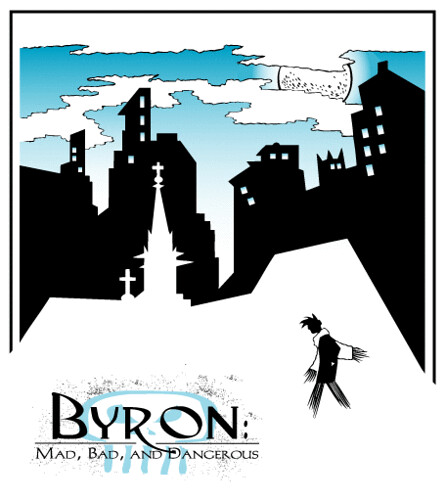
Comics: Currently working on "Byron: Die, Byron! Die" which is the follow up series to "Byron: Mad, Bad, and Dangerous" (currently being published by Slave Labor.com. Can be purchased at: http://www.slgcomic.com// and http://www.eyemelt.com/.) I have also done other comics: "Angst Boy Comics", "Sturm und Drang", and "Shadenfreude".
Website: The easiest place to reach me is my MySpace page. It's got art. There is also my LiveJournal page where I bitch alot about things.
Making comics since year of: I think I started doing Angst Boy about 1998.
Art education/schools attended: None really. Took some art classes at Temple's Tyler school of Art in Philly, but most of my actual comic art was self taught. From working at a comic shop, I knew quite a few other professional cartoonists in Philly who offered me a lot of criticism advice. I also worked at an art supply store for a time, which helped me learn about some of the tools.
Tools
Okay, I create my comics in a weird sort of way. Probably a lot different then most others. I pencil all of my art on one page, using blue lines and lead, and ink the art on a whole other page, using a lightbox to guide me. So, in the end, I have two pages of artwork. I also use my Mac quite a bit. I use Adobe Photoshop to clean up the page and straighten lines. I then convert the art work to an Illustrator document using Adobe Streamline. I letter and place the doc in printer spreads using Adobe Illustrator.
Pencils: I use Stanford Turquoise 02022 Lead Holders rather then actual pencils. I just like the feel of them as well as the sharpener. As actual lead, I use blue lead (doesn't matter what kind: Staedtler or Stanford non-photo blue) for the start of the page before I use HB lead (again: Staedtler or Stanford) to tighten the sketches up.
Inks: I used Winsor & Newton Black India ink for a while. However, I didn't like the kind of varnish they apparently use in it (makes the black look shiny.) I wound up using (and still use) simple Black Sumi Ink. I pick up one of the big green canisters and it lasts me quite a long time.
Brushes: For inking, I use crowquils and brushes. It took me a little while to get use to the crowquils, but love them now. I use the Hunt #107 crowquil point, but will also use a #102 if I can't find a #107. Just love the sharp line that it can create. For brushes, I generally use a size 6 Round brush, though it really doesn't matter what brand. My current brand is Princeton Art & Brush Co.
Pens: I don't use pens any more. I used to use a Koh-I-Noor rapidograph for a long time (cause I worked at an art supply store and could get them at a discount.) However, they were always a pain in the ass with clogging, clean, and they always left me dissatisfied. They are simple to use, but the lines have no wait. So, I have a large stock of them now that I never use.
Paper:I love the 14" x 17" Strathmore 500 Series bristol since it just sucks the ink right up. I also lean now towards Plate bristol rather then the Vellum. I used Vellum bristol for a long time, but after accidently picking up a pad of Plate, I got hooked on the smoothness of the paper. The crowquil just glides over it. Brilliant.
However, since moving to Denver, I haven't been able to find any Strathmore paper at any of the art supply stores (we have only two here in the center of the city.) So, I have been using whatever bristol I can get, mostly Bienfang for my inks. I also use a cheaper bristol for my penciled pages. I could simply use drawing paper (and have in the past), but I like the weight of the bristol.
Lettering/Color: For both lettering/color, I use the Illustrator CS computer program. All of my actual comic pages are b/w, so the only coloring I do is for my covers.
Layout/ Composition:I do my thumbnails on a simple legal pad. I do them quickly and throw them away.
Convention Sketches (when different from illustrations done in the studio): For conventions, I generally use a series of pens. I do the sketch in non-photo blue (it's what I'm most comfortable with) and then do quick inks using a Faber-Castell Black PITT brush pen. Also, if the person asking for the sketch is not annoying and seems appreciative, I will also do a quick color with a Tombo art pen (light blue: #451.) An inked sketch using only one color looks really good.
Tool timeline, starting from when you began drawing in any serious way until the present, and what spurred the changes: I think I pretty much answered most of this above. When I first started with Angst Boy, I used those Comic-Pro blueline comic pages and a series of pens. I then moved to bristol board and rapidographs. I slowly moved away from tech pens and started using crowquils and brushs.
What tools you'd never use, and why: Those Comic-Pro blueline pages and rapidographs. Never again. I've already explains the reasons for the rapidographs. I don't like the blueline pages simply cause I don't see a reason for them. I mean, you can get better blank bristol board cheaper. With the Comic-Pro pages, you are only paying for the easy of the printed guides on the page. You can easily measure them out yourself.
And lastly, any advice you'd like to give: Well, the complaint I hear the most from other artists that are just starting out (and I was guilty of this as well for a time) is that they get stuck on one page. They aren't happy with their results, so they obsess and redraw their comic over and over again. My view is to get over it. Move on. You will improve. It's more important to finish the work and get it out there then to fret on it's not perfect. It will never be. I cringe looking at my earlier work. Even the stuff being published now.
February 5, 2007
Tim Winstead
Comics: 'Stoopid Stuff', ' Delusionz,' 'Now that's a First,' and ' Whatever ' ! ( all single panel cartoons )
Website: http://www.komikstripkartoonzbytimwinstead.com
Making comics since year of: Birth..no,..seriously ..I've been drawing all of my life, whether it be considered doodles of some sort or not, I've had an affinity for drawing for as long as I can remember. Only about 10 years ago did I really try and commit to improving my skills and put my art out there.
Art education/schools attended: I took a 'at home' Master Art ' course thru a school called ICS (International Correspondence Schools ) out of PA. back in the 90's. Aside from that, everything I know or do is self-taught.
Tools:
In as far as tools go..I don't play favorites. I like to experiment with different tools and see what the use of them can offer. As for what I'm using now..I'm trying my hand at using Faber-Castelle Pitt Pens which are easy to use so far and I like the results I get from them.
Paper:even though I treat myself once in a while by getting an actual sketch pad..I use plain old printer paper. I pre-print up mass copies of my panels' 'workable size @ 7 " x 7 " . This size is indicative of each feature I work on allowing of course for the title,and captions.
Brushes:don't use any..at least not for my cartoons. IF and when I make a mural, then I'll use whatever brushes I can find. I'm not into chasing down premier brushes or any other type of ' equipment '.
Lettering: Usually only done by hand if the 'toon calls for it or again, if a mural is in the works..then ALL lettering is done by hand.
Color: Although I can color by hand, it's more of a benefit to me to do it via p.c.
Layout / composition: no set standard here either. again, my toons are dependent on how well the gag is written. From ' A' where the gag is penned..to ' B ' ' tweaking ' the rough...to ' C ' ' fine-lining ' the final pencil. Then, shading indicators are made. After that.. the inking begins and finally, any pencils that remain are erased .
The toon is then scanner-bound and imported to my arcaheic version of PS 6.0 where final touches such as color and text are done. In the end, a file is saved..hard copy printed..and toon is finally published on my site.
Convention Sketches : Never done any.
Tools I'd never use: crayons..lol...actually the only tool I'm not into is the ' tablet'. Sorry, it's that 'old school ' in me, but paper has to be the primary media..no ifs ands or buts.
Advice: hmmm...not really. A person will only cull from advice given if it meets with goals or weaknesses that one is concerned about. I just always try to remember why it is that I strive to be a professional cartoonist and what it is that appeals to me about the craft. If money comes before anything else and your only goal is fame..you are bound to be bound by the whims of others who may have little concern for you as an artist and more as one who will serve their interests alone. If, on the other hand, you remain true to the craft itself..the ethics of this special community...and the joy you bring others who see your work as that of someone who truly loves what he or she does........there can really be no better fortune than that.
Sounds a bit corny, I know........but that's how I roll.
January 23, 2007
Jenny Gonzalez

Comics:Too Negative
Website: http://www.jennydevildoll.com
Making comics since year of: 1995
Art education/schools attended: Parson's School of Design
Tools
Pencils: Usually just the mechanical pencils I get at the 99 cent store--this is a pretty lo-fi operation here!
Inks: The Japanese brush pen I use comes with it's own cartridges of ink.
Brushes: none
Pens: I have an assortment of pens mostly from Kinokuniya, this Japanese bookstore in Rockefeller Plaza. Ironically, the main one I use is manufactured by an American company, Pentel, but only distributed in Japan, so they have to import them! Another one I have has the Mitsubishi logo on it, like the car. I like the brush pens because of the variety of line you can get with them. I also have a fine tipped mechanical pen for doing background stuff where I don't want the line to be as strong. Oh, and I also use the plain old Pilot Precise V, available at any drugstore for lettering and Sharpies for filling in large black areas.
Paper: I like to use Vellum paper even though it's a little more expensive. Though I've also been known to draw full comix on the back of junk faxes we get at work.
Lettering: It's all hand lettering
Color: When I do color strips for my online site I do it on Photoshop. Otherwise most of my stuff appears in black and white.
Layout/ Composition: I don't really think about it as much as I should, unfortunately. I just get so caught up in doing the drawings and moving the story along that most of my composition is very basic.
Convention Sketches (when different from illustrations done in the studio): I'm usually way too wired at conventions to sit and sketch. :) But if I did I'd probably use the same tools.
Tool timeline, starting from when you began drawing in any serious way until the present, and what spurred the changes: I've experimented with rapidographs, crowquills, and assorted calligraphy and brush pens trying to get a line I really like. So far the Japanese Pentel pen does it!
What tools you'd never use, and why: The Sakura brush pen. It's felt and the point gets blunt really quickly, so you can only get fine lines with it when it's brand new.
And lastly, any advice you'd like to give: The world needs more beautiful drawing.
January 16, 2007
Sorry for the long absence. I had a project that was devouring my time, but it's nearly done now, so I'm slowly beginning the blog again. No interviews for the moment, ideally I'll be back into them by next week, but here's a few links:
-There's a discusion going on at Make Comics Forever about lettering techniques that y'all might find interesting.
-Matt Bernier keeps a blog in which he talks about things relating to his comics, including some comments on paper. He also sent me this email after I posted about the T-3 nibs:
If you go here: http://mattious.deviantart.com/gallery/, every single thing not inked with a brush was inked with the T-3 nib. (Except panel borders and lettering.) Literally everything. And most of it with the same one, which I still have in my pen holder.
-Matt
So check those out!
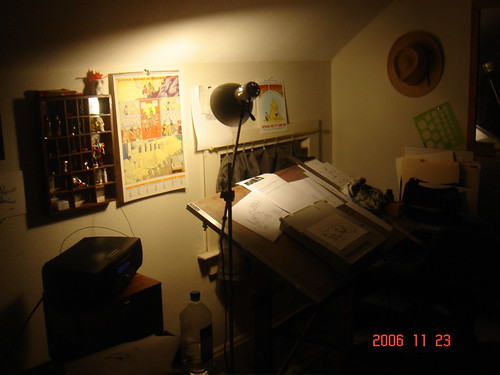
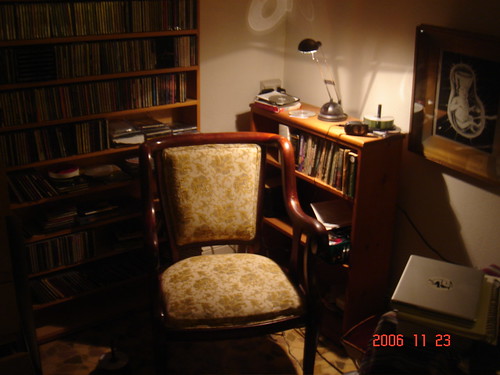
-Shannon Wheeler sent me some pics of his studio & study awhile back which I had neglected to put up til now:
-There's a discusion going on at Make Comics Forever about lettering techniques that y'all might find interesting.
-Matt Bernier keeps a blog in which he talks about things relating to his comics, including some comments on paper. He also sent me this email after I posted about the T-3 nibs:
If you go here: http://mattious.deviantart.com/gallery/, every single thing not inked with a brush was inked with the T-3 nib. (Except panel borders and lettering.) Literally everything. And most of it with the same one, which I still have in my pen holder.
-Matt
So check those out!
-Shannon Wheeler sent me some pics of his studio & study awhile back which I had neglected to put up til now:
December 11, 2006
Have I mentioned I need surveys? I do. Bad. So if you haven't done so yet, and you've been making comics for a long enough length of time to experiment with your tools, take the survey.
-MK
-MK
December 8, 2006
Katie Skelly

Comics: Discomaxx, Sourpuss, Worrywort
Website: http://www.calicocomics.com and drawing journal at http://pandahex.blogspot.com
Making comics since year of: 2003
Art education/schools attended: Moore College of Art + Design, Syracuse University
Tools
Pencils: I like Bic mechanical pencils, preferably 0.7
Inks: India ink, but rarely used
Brushes: I do some gouaches from time to time but usually just take whatever I can get here!
Pens: My favorite pen is the Papermate Flair pen, in any color, but usually black. It gives a really smooth line that is just thick enough. Even though they aren't meant for drawing, they have never bled on me. They are very fun to draw with, and your drawings will look instantly finished and very graphic. I also use Sharpies when I think something needs a little extra kick, but rarely.
Paper: Nothing fancy, but I do like Strathmore watercolor paper when I do gouaches.
Lettering: By hand with my trusty Papermate flair.
Color: Photoshop and occasionally gouache.
Layout / Composition: I draw composition ideas on computer paper and often like them so much that I ink them immediately. In terms of influence, I will reference the drawings of George Grosz.
Tool timeline, starting from when you began drawing in any serious way until the present, and what spurred the changes: I started using Microns a lot because they were recommended to me when I first started doing comics. I could never find the right thickness and couldn't understand how to apply the appropriate amount of pressure with those. They are a little too delicate for me. Then I tried brush pens, but those were another dud. Then one day I saw my friend drawing with Papermate Flairs and loved what he was doing, so I tried them out and I've stuck with them ever since.
What tools you'd never use, and why: Brush pens. They just aren't my style because they allow for a lot of line variance. I like to keep my lines very narrow.
And lastly, any advice you'd like to give: You may think you have to spend a lot of cash money, but in the end you should just use what best suits you. The sooner you find what suits you, the more money you will save. You don't need the fanciest stuff to do your best work. Don't look back!
Subscribe to:
Posts (Atom)